
Decision Tree in Data Mining: A Complete Guide (With Examples, Algorithms & Applications)
Table of Contents
Introduction
Decision tree in data mining is one of the most widely used techniques for extracting meaningful patterns from large datasets. Whether you’re classifying customer behavior, predicting loan defaults, or diagnosing diseases, decision trees offer a transparent and powerful model for making data-driven decisions.
In this comprehensive guide, you’ll learn everything about decision trees in data mining — from how they work and the algorithms behind them, to real-world applications and best practices for avoiding common pitfalls like overfitting.
What Is a Decision Tree in Data Mining?
A decision tree in data mining is a supervised machine learning algorithm that uses a hierarchical, tree-like structure to classify or predict outcomes from a dataset. It mimics the human decision-making process by asking a series of yes/no or conditional questions, splitting data step-by-step until a final answer is reached.
The structure consists of:
- Root Node — The starting point, representing the entire dataset. The first and most important split happens here.
- Internal Nodes (Decision Nodes) — Intermediate points where the data is evaluated based on a specific feature or attribute.
- Branches — The pathways that connect nodes, representing the outcome of each decision.
Leaf Nodes (Terminal Nodes) — The endpoints of the tree where a final prediction or classification is made.
A Simple Example
Imagine a bank wants to decide whether to approve a loan application. The decision tree might first check: Is the applicant’s credit score above 700?
- If yes, it checks income level.
- If no, it moves to check employment status.
Each branch narrows down the data until the tree reaches a leaf node — “Approve” or “Reject.”
This transparent logic is one of the key reasons decision trees are so popular in data mining: you can follow the reasoning behind every prediction.
How Does a Decision Tree Work in Data Mining?

Decision trees in data mining use a divide-and-conquer strategy, recursively splitting data from the top down. Here’s the step-by-step process:
- Start at the Root Node — The algorithm evaluates all available features and selects the one that best separates the data.
- Apply a Splitting Criterion — Using metrics like Gini Impurity, Entropy, or Information Gain, the algorithm finds the optimal threshold for the split.
- Create Branches — The data is divided into subsets based on the chosen feature.
- Repeat Recursively — Each subset becomes a new node, and the process repeats until a stopping condition is met.
- Assign Leaf Nodes — When no further meaningful splits exist, the final category or prediction is assigned.
The goal at every step is to create subsets that are as homogeneous (pure) as possible — meaning each group contains predominantly one class or outcome.
Splitting Criteria in Decision Trees
The choice of splitting criterion is what drives the quality of a decision tree. The three most common criteria are:
1. Gini Impurity
Used primarily in the CART algorithm. Gini Impurity measures the probability that a randomly chosen element from a node would be incorrectly classified. A Gini value of 0 means perfect purity (all data points belong to one class). Lower values indicate better splits.
Formula:
Gini = 1 − Σ(pᵢ²)
Where pᵢ is the proportion of each class at the node.
2. Entropy and Information Gain
Used in ID3 and C4.5 algorithms. Entropy measures the level of disorder or uncertainty in a dataset. The algorithm selects the feature that produces the greatest Information Gain — the biggest reduction in entropy after a split.
Formula:
Entropy = − Σ(pᵢ × log₂(pᵢ))
3. Chi-Square
Used in the CHAID algorithm. It measures the statistical significance of the difference between observed and expected class frequencies, making it especially useful for categorical variables.
Types of Decision Trees in Data Mining
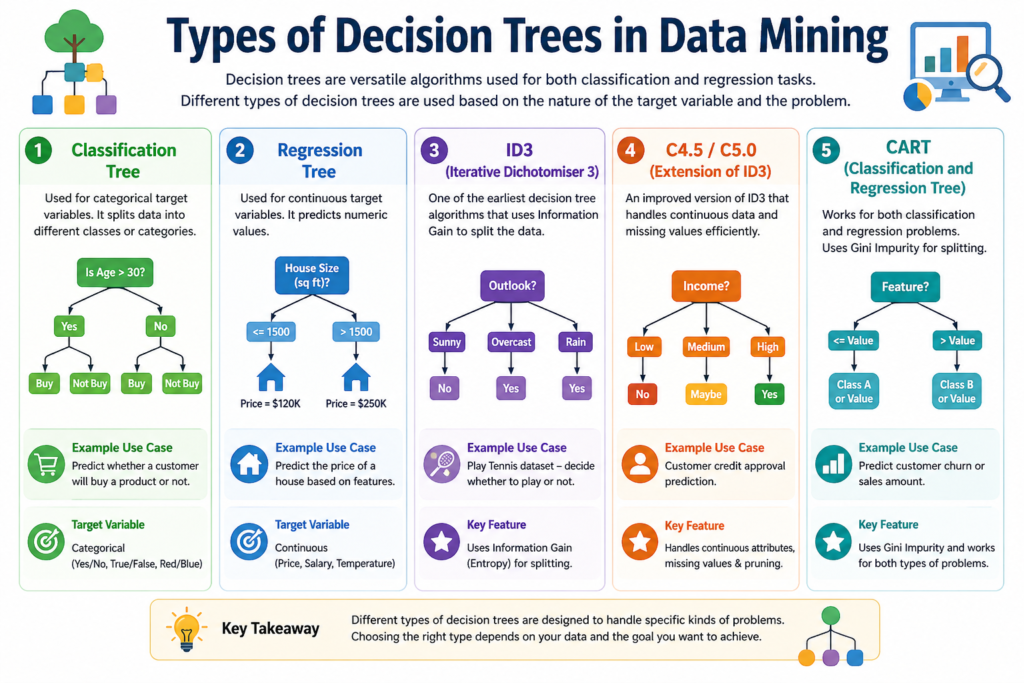
There are two primary types of decision trees, based on the nature of the target variable:
Classification Trees
Used when the output is a categorical variable — for example, spam vs. not spam, fraud vs. legitimate, or approved vs. rejected. The tree assigns data points to predefined categories.
Example: Predicting whether a patient has diabetes based on blood sugar levels, BMI, and age.
Regression Trees
Used when the output is a continuous variable — for example, predicting house prices, stock values, or temperature. Instead of a class label, the leaf node returns a numerical prediction.
Example: Estimating the selling price of a property based on its location, size, and number of bedrooms.
Decision Tree Algorithms in Data Mining
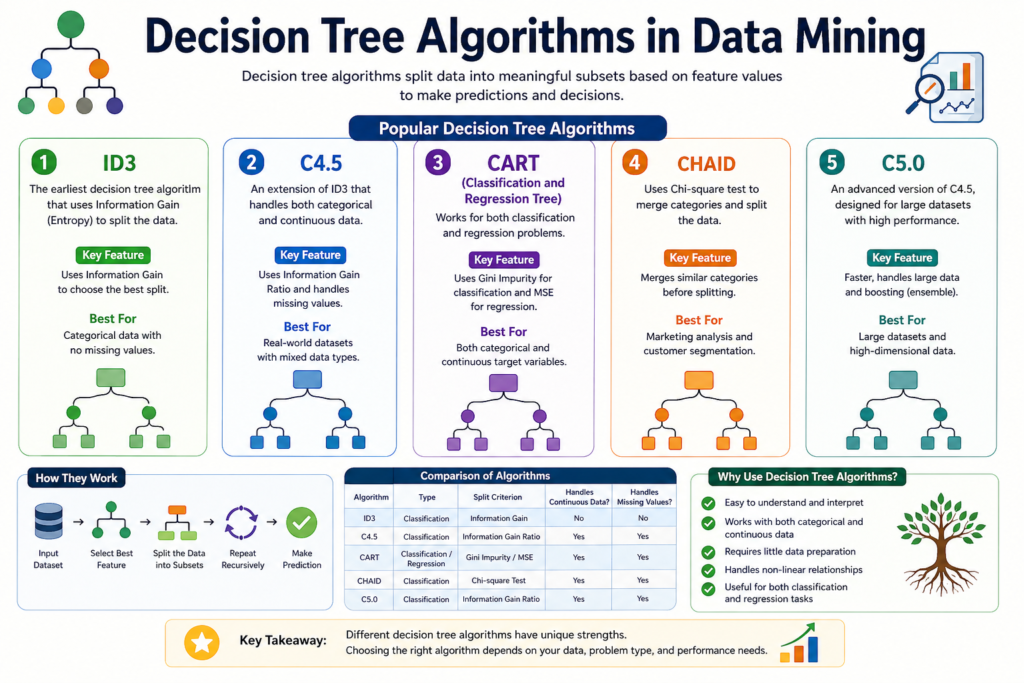
Multiple algorithms have been developed over the decades to build decision trees more accurately and efficiently. Here’s a detailed breakdown of the five most important ones:
1. ID3 (Iterative Dichotomiser 3)
Developed by J. Ross Quinlan in 1986, ID3 was one of the first widely-adopted decision tree algorithms. It uses Information Gain based on Entropy to evaluate candidate splits.
- Treats the entire dataset as the root node
- Iterates over all attributes to find the best split
- Limitation: Only handles categorical data; prone to overfitting; does not support pruning
2. C4.5
An evolution of ID3, also developed by Quinlan. C4.5 improves on its predecessor in several ways:
- Handles both discrete and continuous attribute values
- Uses Gain Ratio instead of raw Information Gain to avoid bias toward attributes with many values
- Supports pruning to reduce overfitting by removing statistically insignificant branches
- Can handle missing values during training
3. CART (Classification and Regression Trees)
Introduced by Leo Breiman and colleagues in 1984, CART is one of the most versatile and widely-used algorithms today.
- Produces binary trees — every node splits into exactly two branches
- Uses Gini Impurity for classification and Mean Squared Error (MSE) for regression
- Supports cost-complexity pruning
- Forms the backbone of ensemble methods like Random Forests and Gradient Boosting
4. CHAID (Chi-square Automatic Interaction Detector)
CHAID is a multi-split algorithm (not limited to binary splits) that uses the Chi-square test to evaluate splits.
- Works with continuous, ordinal, and nominal variables
- Particularly effective for survey and market research data
- Stops splitting when the Chi-square result is not statistically significant
- Uses the F-test for continuous dependent variables
5. MARS (Multivariate Adaptive Regression Splines)
MARS is a more advanced technique designed for non-linear data.
- Creates piecewise linear functions called “splines” to model complex relationships
- Ideal for regression tasks involving interactions between multiple variables
- More flexible than standard decision trees for high-dimensional continuous data
Pruning: Preventing Overfitting in Decision Trees

One of the most critical challenges in decision tree data mining is overfitting — when the tree memorizes training data instead of learning generalizable patterns, leading to poor performance on new data.
Pruning is the solution. It simplifies the tree by removing branches that provide little predictive value.
Pre-Pruning (Early Stopping)
The tree stops growing before it becomes too complex by applying constraints such as:
- Maximum tree depth
- Minimum number of samples per leaf
- Minimum improvement in the splitting criterion
Post-Pruning
The tree is allowed to grow fully, then branches are removed backward from the leaf nodes. The most common method is cost-complexity pruning (also called weakest link pruning), which finds the optimal trade-off between tree complexity and accuracy.
Why pruning matters:
A well-pruned tree is simpler, faster to deploy, more interpretable, and more accurate on unseen data.
Advantages of Decision Trees in Data Mining
|
Advantage |
Description |
|---|---|
|
Interpretability |
The tree structure is easy to visualize and explain to non-technical stakeholders |
|
No Feature Scaling Required |
Unlike SVM or k-NN, decision trees don’t require data normalization |
|
Handles Mixed Data Types |
Can process both numerical and categorical features in the same model |
|
Non-linear Relationships |
Captures complex patterns that linear models miss |
|
Missing Value Handling |
Can assign default values or ignore missing data during splits |
|
Low Human Intervention |
Minimal preprocessing needed, reducing time and potential for human error |
|
Feature Importance |
Automatically identifies which features contribute most to predictions |
Disadvantages of Decision Trees in Data Mining

Despite their strengths, decision trees come with notable limitations:
- Overfitting — Deep trees can memorize noise in training data. Pruning and ensemble methods help mitigate this.
- Instability — Small changes in data can produce dramatically different trees, making them sensitive to variance.
- Bias toward high-cardinality features — Features with many unique values may be selected too often, skewing results.
- Difficulty with complex interactions — They may miss subtle feature interactions that more sophisticated models capture.
- Computationally expensive for large datasets — As tree depth increases, computational cost grows significantly.
Applications of Decision Trees in Data Mining

Decision trees are used across nearly every industry because of their combination of accuracy, speed, and transparency:
1. Banking and Finance
- Loan approval: Evaluates credit score, income, employment history, and debt ratio to accept or reject applications.
- Fraud detection: Analyzes transaction patterns to flag suspicious activity for investigation.
- Risk assessment: Determines borrower default probability based on historical repayment data.
2. Healthcare and Medicine
- Disease diagnosis: Predicts conditions like diabetes, heart disease, or cancer based on clinical parameters (glucose, BMI, age, blood pressure).
- Drug effectiveness: Forecasts how a patient will respond to a treatment based on their health profile.
- Patient triage: Prioritizes patients in emergency settings based on symptom severity.
3. Marketing and Customer Analytics
- Churn prediction: Identifies customers likely to leave based on purchase history, engagement, and complaint frequency.
- Customer segmentation: Groups customers by behavior for targeted marketing campaigns.
- Campaign response modeling: Predicts which customers will respond to a promotional offer.
4. Education
- Student performance prediction: Flags at-risk students based on attendance, grades, and engagement.
- Admissions screening: Shortlists applicants by academic scores and merit indicators.
- Resource allocation: Helps institutions identify where support is most needed.
5. Cybersecurity
- Intrusion detection: Classifies network traffic as normal or malicious in real time.
- Spam filtering:Categorizes emails as spam or legitimate based on content features.
Decision Tree vs. Other Data Mining Methods
|
Method |
Best For |
Interpretability |
Handles Non-linearity |
|
Decision Tree |
Classification & Regression |
Very High |
Yes |
|
Linear Regression |
Continuous output, linear data |
High |
No |
|
Random Forest |
High accuracy, complex data |
Medium |
Yes |
|
Neural Networks |
Complex patterns, large data |
Low |
Yes |
|
SVM |
High-dimensional classification |
Medium |
Yes (with kernel) |
Decision trees excel when interpretability matters — in regulated industries like finance and healthcare where decisions must be explainable.
Decision Trees as a Foundation for Advanced Models
Decision trees are not just standalone models — they’re the building blocks of some of the most powerful algorithms in machine learning:
- Random Forest: Builds hundreds of uncorrelated decision trees and averages their predictions, dramatically reducing variance while maintaining accuracy.
- Gradient Boosting (XGBoost, LightGBM): Builds trees sequentially, where each new tree corrects the errors of the previous one. Currently one of the top-performing approaches for tabular data.
- AdaBoost: Combines multiple weak decision trees (stumps) into a strong classifier.
Mastering decision trees in data mining gives you the conceptual foundation to understand and apply all of these advanced ensemble methods.
Conclusion
Data analysis has become an essential skill in today’s data-driven world, influencing how individuals, businesses, and governments make decisions. By converting raw, unstructured data into meaningful insights, data analysis helps uncover patterns, trends, and relationships that support informed and strategic actions. Organizations use data analysis to improve efficiency, understand customer behavior, reduce risks, and drive innovation, ultimately achieving sustainable growth and competitive advantage. For individuals, strong data analysis skills enhance problem-solving abilities and increase career opportunities across diverse industries such as finance, healthcare, marketing, technology, and education.
As data volumes continue to grow and technologies evolve, the role of data analysts is becoming more impactful, shifting toward interpretation, storytelling, and decision support rather than manual processing. Whether you are just beginning your learning journey or aiming to advance your expertise, mastering data analysis equips you with a powerful skill set that remains relevant, adaptable, and valuable. Embracing data analysis opens the door to endless opportunities in an increasingly digital and information-centric world.
FAQ's
- Classification Tree – Used for categorical outcomes (Yes/No).
- Regression Tree – Used for continuous values (numbers).
- CART (Classification and Regression Tree) – Handles both classification and regression.
- CHAID (Chi-Square Automatic Interaction Detection) – Uses statistical tests for splitting.
- Supervised Learning – Uses labeled data (e.g., classification, regression).
- Unsupervised Learning – Finds patterns in unlabeled data (e.g., clustering).
- Reinforcement Learning – Learns through rewards and penalties.
A decision tree is a flowchart-like model that splits data into branches to make decisions or predictions.
Yes, ChatGPT can create decision trees in text, diagrams, or code based on your data or problem.
- Strategic
- Tactical
- Operational
- Programmed
- Non-programmed
- Individual
- Group
- Root Node – Starting point
- Decision Nodes – Points where data splits
- Leaf Nodes – Final outcomes or decisions